| Theodor
Loos
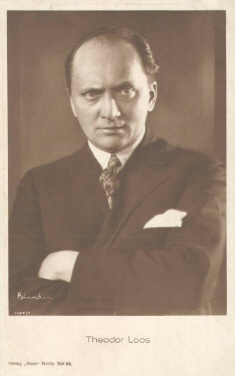
Foto: Alexander Binder (1888-1929)
1883
- 1954 |
.
.
Theodor Loos was born in Zwingenberg/Hessen. After first professional
experiences in the music business and arts and crafts he seized the profession
of an actor in Leipzig in 1902. He came to Berlin in 1912 via the Theater
of Frankfurt and was engaged by Max Reinhardt for the Deutsches Theater.
He soon became established as a demanded character actor and very versatile
actor who was especially connected with the Lessing theater.
Theodor Loos' film debut also fell in this time. He already appeared
in 1913 in the movie "Das goldene Bett", it soon followed other cinematic
works like "Das Haus ohne Tür" (14), "Die Rache der Thora West" (15),
"Der geheimnisvolle Wanderer" (15) in his first leading role, "Homunculus"
(1916), "Christa Hartungen" (17), "Es werde Licht!" (1918) and "Nachtgestalten"
(1919).
The 20s were impressed by great theater roles and engagements in some
of the most important silent movies of the German film history. A lot of
the greatest directors of this time worked together with him. Theodor Loos
fascinated at the theater with his natural speech art and in his movies
he impressed the audience with his striking features and his expressive
eyes which intensified his performance in front of the camera.
The numbers of movies and their quality in which he was involved are
impressive. To these productions belong "Kurfürstendamm" (20), "Steuermann
Holk" (20), "Der Reigen - Ein Werdegang" (20), "Lady Hamilton" (21), "Jugend"
(22), "Hanneles Himmelfahrt" (22), "Friedrich Schiller" (23), "Die Nibelungen:
Siegfried" (24), "Die Nibelungen: Kriemhilds Rache" (24), "Der Herr der
Nacht" (26), "Manon Lescaut" (26), the classic "Metropolis" (26), "Die
Weber" (27), "Luther" (27), "Köngin Luise" (28) and "Atlantik" (29),
his first sound film.
When the sound film became definitely established in the 30s this circumstance
redounded to his his advantage because he was not only a gifted actor but
also had an ideal voice for the big screen.
Therefore these years offered him again countless engagements in front
of the camera he was able to impersonate the roles in a fascinating way.
To these movies belong "Rasputin, Dämon der Frauen" (30), "Zwei Menschen"
(30), "1914, die letzten Tage vor dem Weltbrand" (30), "M - Eine Stadt
sucht einen Mörder" (31), "Yorck" (31), "Schuss im Morgengrauen" (32),
"Das Testament des Dr. Mabuse" (33), "Ein gewisser Herr Gran" (33), "Wilhelm
Tell" (34), "Der Student von Prag" (35), "Der alte und der junge König"
(35), "Viktoria" (35), "Verräter" (36), "Der Herrscher" (37) and "Robert
Koch, der Bekämpfer des Todes" (39).
During the confusions of World War II he was able to continue his film
career as well as his stage career. Among others he took part in the propaganda
movie "Jud Süss" (40), "Kora Terry" (41), "Rembrandt" (42), "Reise
in die Vergangenheit" (43), "Titanic" (43) and "Der Fall Molander" (45).
After the war he was not able to continue his former successes, among
others he was confronted with the criticism that he took part in propaganda
movies which led to a short-time occupational ban. Only after his rehabilitation
by the French military government he was able to continue his acting career.
Theodor Loos dedicated again more often to the theater where he especially
played at the Staatstheater Stuttgart till his death.
But also in the film business he appeared now and then, but normally
in support roles.
To these movies belong "Mordprozess Dr. Jordan" (49), "Die Gefangene
des Maharadscha" (53) and "Sterne über Colombo" (53).
On the verge of his death he was awarded with the Verdienstkreuz of
the Verdienstordens of the federal republic Germany.
Other movies with Theodor Loos:
Die Eisbraut (13) Sein einziger
Bruder (13) Im Schützengraben (14) Der Sohn des Ministers (15) Der
zwölfjährige Kriegsheld (15) Doch die Liebe fand den Weg (15)
Maria Niemand und ihre zwölf Väter (15) Frau Eva (16) Abseits
vom Glück (16) Das Haus der Leidenschaften (16) Das letzte Spiel (16)
Die Richterin von Solvigsholm (16) Friedrich Werders Sendung (16) Das Gewissen
des Anderen (17) Die schwarze Lo (17) Das Licht in der Nacht (17) Das Buch
des Lasters (17) Edelsteine (17) ...und führe uns nicht in Versuchung
(17) Nach dem Gesetz (19) Die Launen eines Milliardärs (19) Opfer
der Blutrache (19) Dämmernde Nächte (20) Das Wüstengrab
(20) Der zeugende Tod (20) Die Geheimnisse von New York (20) Die Nacht
der Prüfung (20) Geschwister Barelli (20) Sehnende Liebe (20) Der
Menschheit Anwalt: Das Wunder der Zeiten (20) Christian Wahnschaffe: Weltbrand
(20) Das Haus in der Dragonergasse (21) Der Schatz der Azteken (21) Der
rätselhafte Tod (21) Das Gelübde (21) Die kleine Dagmar (21)
Die Schuldige (21) Das blinde Glück (22) Der Kampf ums Ich (22) Schuld
und Sühne (22) Es leuchtet meine Liebe (22) Macht der Versuchung (22)
Othello (22) Der Aufstieg der kleinen Lilian (23) Claire (24) Soll und
Haben (24) Wunder der Schöpfung (25) Der erste Stand (25) Götz
von Berlichingen zubenannt mit der eisernen Hand (25) Der tanzende Tod
(25) Was Steine erzählen (25) Frauen der Leidenschaft (26) Das Lebenslied
(26) Liebeshandel (26) Zopf und Schwert (26) Der Veilchenfresser (26) Bigamie
(27) Prinz Louis Ferdinand (27) Notschrei hinter Gittern (27) Die Hochstaplerin
(27) Petronella (27) Anastasia, die falsche Zarentochter (28) Die Sache
mit dem Schorrsiegel (28) Sensationsprozess (28) Heimkehr (28) Diane (29)
Ludwig der Zweite, König von Bayern (29) Die Nacht des Schreckens
(29) Napoleon auf St. Helena (29) Vertauschte Gesichter (29) Blutschande
- § 173 St.G.B. (29) Die große Sehnsucht (30) Das Flötenkonzert
von Sans-souci (30) Boykott (30) Die andere Seite (31) Ariane (31) Im Geheimdienst
(31) Der Fall des Generalstabsoberst Redl (31) Ich geh' aus und du bleibst
da (31) Acht Mädels im Boot (32) Die elf Schill'schen Offiziere (32)
Das Geheimnis des blauen Zimmers (32) Die unsichtbare Front (32) Grün
ist die Heide (32) An heiligen Wassern (32) Tod über Shanghai (32)
Marschall vorwärts (32) Goethe - Gedenkfilm (32) Was wissen denn Männer
(32) Der Judas von Tirol (33) Wege zur guten Ehe (33) Höllentempo
(33) Die blonde Christl (33) Die Freundin eines großen Mannes (34)
Hanneles Himmelfahrt (34) Ein Mädchen mit Prokura (34) Die Spork'schen
Jäger (34) Der grüne Domino (35) Das Mädchen Johanna (35)
Das Mädchen vom Moorhof (35) Stradivari (35) Schlußakkord (36)
Der Abenteurer von Paris (36) Die Stunde der Versuchung (36) Weiße
Sklaven (36) Monika (37) Die gläserne Kugel (37) Das Geheimnis um
Betty Bonn (37) Geheimzeichen LB 17 (38) Kameraden auf See (38) Schatten
über St. Pauli (38) Der Maulkorb (38) Roman eines Arztes (39) Parkstrasse
13 (39) Falschmünzer (40) Alarm (41) Heimaterde (41) Andreas Schlüter
(42) Die Entlassung/Schicksalswende (42) Die Sache mit Styx (42) Gabriele
Dambrone (43) Philharmoniker (44) Shiva und die Galgenblume (45) Geld ins
Haus/Der Millionär (47) Rosen aus dem Süden (54) |
